Door Trolley for a Leading Automotive Manufacturer
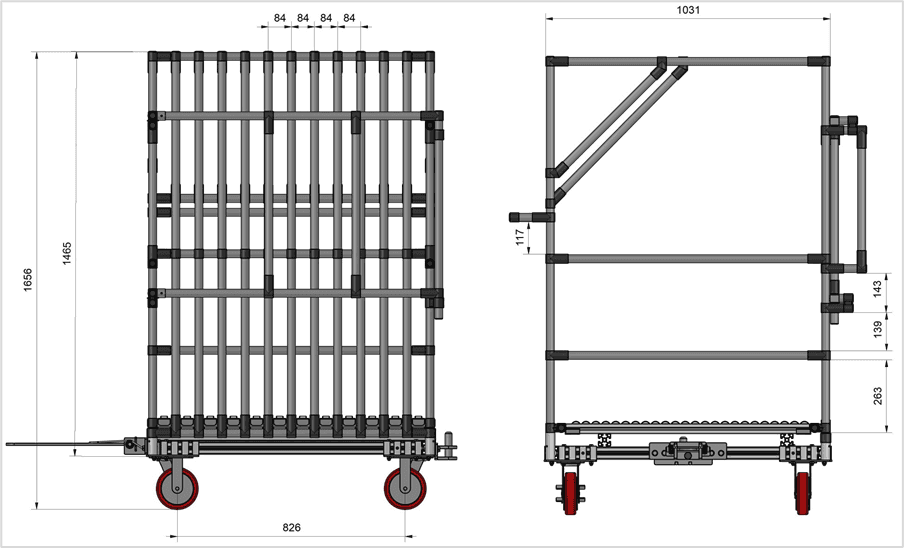
- doors per trolley
- 12
- total load capacity
- 760 kg
- door-to-door contact points
- 0
- tow hitch / drawbar
- Tugger-ready
The Challenge:
Doors were stacked horizontally, one directly on top of the next. Every door in the stack except the top one had a finished face in full contact with another door, and the lower doors carried the combined weight of all the doors above them. Placing a door onto the stack, sliding it off, and the vibration of moving the stack all caused surface-to-surface rubbing, which resulted in scratches, scuffs, and dents on the doors. Damaged doors then needed touch-up or rework before they could be used. Reaching a door lower in the stack also meant lifting off every door above it first, adding handling time, and each additional lift was another chance to damage a door.
Proposed Solution:
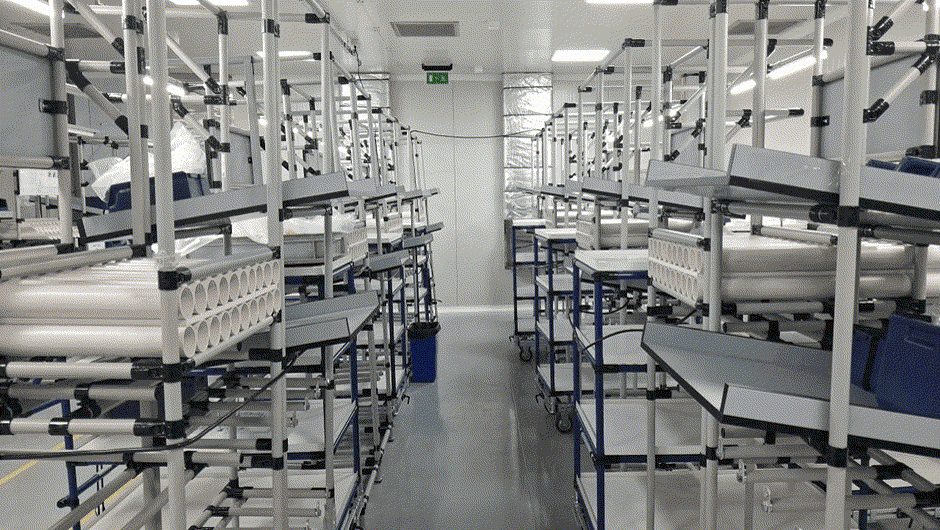
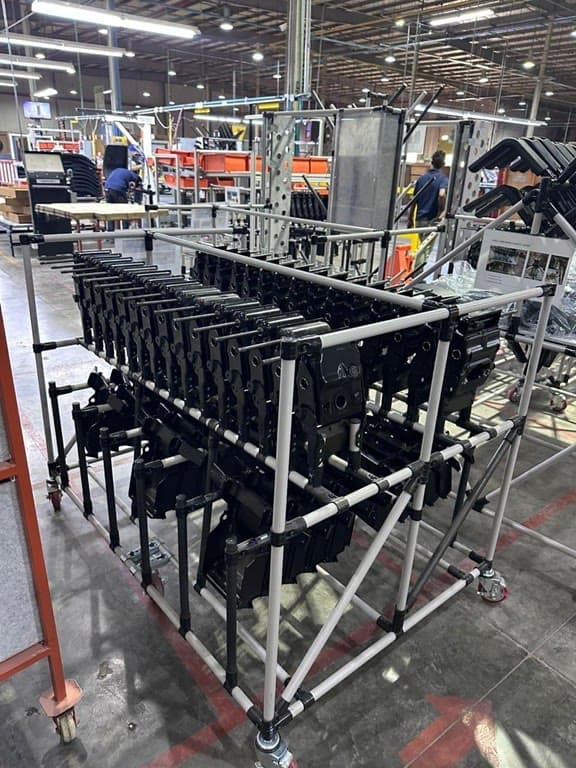
ADAPTIV proposed replacing the stack with a dedicated door trolley built from its modular pipe-racking system. The trolley holds 12 doors standing vertically, each in its own slot between vertical dividers, so doors are separated from one another instead of resting on each other. A roller deck along the bottom platform lets a door be rolled into or out of its slot on its edge rather than lifted and dragged. The trolley runs on heavy-duty castors with an integrated pull handle for manual moves, and a towing hitch / drawbar at the base allows it to be coupled to a tugger train or automated material-handling system.
- Capacity
- 12 doors, each held vertically in its own partitioned slot.
- Load rating
- 760 kg total load capacity (uniformly distributed), i.e. roughly 63 kg per door on average when all 12 slots are full.
- Construction
- Modular tubular pipe-racking frame with reinforced joints and diagonal structural bracing.
- Mobility
- Heavy-duty castors, pull handle, and towing hitch / drawbar for tugger-train integration.
Design Principles:
- No door-to-door contact: each door has its own slot, separated from other doors by vertical dividers, removing the face-to-face rubbing that caused the scratches.
- No load on the door faces: doors stand upright on their edge, so no door carries the weight of another, unlike the bottom of a stack.
- Direct access to every door: any door can be taken out directly from its slot without moving the others, removing the need to unstack and restack.
- Low-friction loading: the roller deck lets heavy doors be rolled in and out rather than lifted and dragged, reducing operator effort and handling damage during loading and unloading.
- Modular, reconfigurable frame: the tubular profile system with reinforced joints and bracing can be adjusted or reconfigured if door sizes or quantities change.
- Flexible mobility: 12 doors move as one unit, pushed manually by the handle or towed by a tugger via the drawbar.
Estimated Benefits:
The figures below are engineering estimates based on standard lean / ergonomics time-and-motion assumptions and the pallet and trolley dimensions involved. They are planning estimates, not a measured result at this site; ADAPTIV recommends a short time-and-motion study and a footprint check after the trolley is built and placed at the line to confirm the actual numbers.
Estimated damage reduction:
- In a stack of 12 doors, 11 doors have a face resting on another door, and the bottom door carries the weight of the 11 above it. On the trolley, the number of door-to-door contact points drops to zero.
- Because the contact that causes stacking scratches no longer exists, the majority of stacking-related surface damage is expected to be eliminated at the source. Any remaining handling damage is further reduced by rolling doors on the roller deck instead of dragging them.
- Fewer damaged doors mean less touch-up, rework, and replacement, and fewer delays waiting for a usable door.
Estimated handling time savings:
- Retrieving a door from a random position in a stack of 12 means moving, on average, about 5–6 doors off the stack and back on again. At an estimated 10–15 seconds per lift for a heavy door, that is roughly 2–3 minutes per door retrieved.
- On the trolley, sliding a door out of its slot on the roller deck is estimated at roughly 15–25 seconds, regardless of which slot it is in.
- This points to an estimated saving of roughly 1.5–2.5 minutes each time a door is needed out of stack order. When doors are always taken strictly from the top of the stack, the time saving is smaller, but the damage-reduction benefit still applies.
- Heavy lifting at floor level to build or break down the stack is largely replaced by rolling doors at deck height, reducing operator strain and the number of people needed per door move.
Project Status:
Door Trolley has been delivered and is in use at the client's plant. The client has confirmed they are satisfied with the result: doors are now stored and moved upright in individual slots instead of being stacked.
Other case studies
See all case studies